The Hidden Truth About Gum Treatment
Why 90% of Patients Choose the Wrong Gums Option First
When Margaret first noticed her gums bleeding during her morning routine, she did what most people do—she dismissed it as “just aggressive brushing.” Three months later, facing a diagnosis of moderate periodontitis, she realized she had fallen into the same trap as 90% of patients: assuming all gum treatments are created equal.
The reality is that choosing the right gum treatment option can mean the difference between saving your natural teeth and facing a lifetime of dental complications. With traditional surgical approaches, minimally invasive laser therapy, and regenerative procedures all claiming to be “the best solution,” how do you navigate this critical decision?
Understanding Your Treatment Landscape
Non-Surgical Options: The Conservative Approach
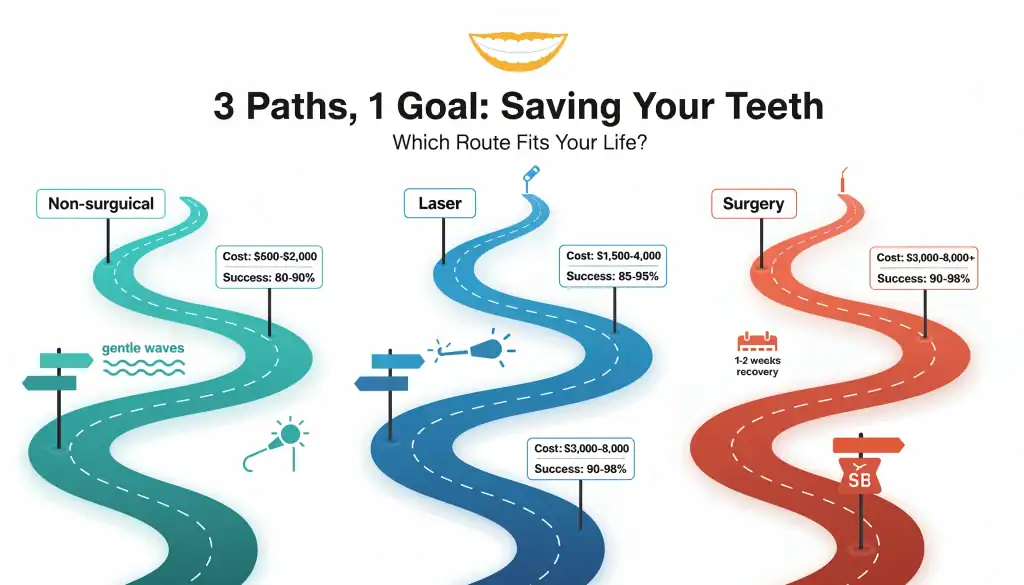
Scaling and root planing, often called “deep cleaning,” remains the gold standard first-line treatment for mild to moderate gum disease. This procedure involves removing bacterial plaque and calculus from below the gumline and smoothing root surfaces to prevent future bacterial colonization.
The key advantage? It’s minimally invasive and often sufficient to halt disease progression when combined with excellent home care. However, deeper pockets (7mm+) typically require more aggressive intervention.
Laser Periodontal Therapy: The Modern Alternative
Laser-Assisted New Attachment Procedure (LANAP) uses specific wavelengths to selectively remove diseased tissue while preserving healthy structures. This FDA-approved treatment offers reduced bleeding, swelling, and recovery time compared to traditional surgery.
The trade-off? Limited long-term data compared to traditional methods, and not all cases are suitable for laser treatment.
Traditional Surgical Approaches: The Proven Standard
Flap surgery (pocket reduction) provides direct access to infected areas, allowing thorough cleaning and bone recontouring. When combined with regenerative materials, it can actually rebuild lost tissue.
While more invasive, surgical approaches offer the most predictable long-term outcomes for severe cases.
The Decision Framework: 5 Critical Factors
- Disease Severity Assessment
Your periodontist will measure pocket depths around each tooth. Pockets 4mm or less often respond well to non-surgical treatment, while 7mm+ typically require surgical intervention. The pattern of bone loss—horizontal versus vertical—also influences treatment selection. - Your Health Profile
Diabetes, smoking, and certain medications significantly impact healing and treatment success. Smokers, for instance, have 50% lower success rates with all periodontal treatments and may need more aggressive initial approaches. - Lifestyle Considerations
A busy executive might prioritize laser treatment for minimal downtime, while someone with dental anxiety might prefer the predictability of traditional approaches under sedation. Consider your work schedule, pain tolerance, and ability to maintain post-treatment care. - Long-term Goals
Are you planning orthodontics, implants, or cosmetic procedures? Some treatments create better foundations for future dental work. Regenerative procedures, while more expensive initially, might eliminate the need for bone grafting later. - Financial Reality
Insurance typically covers 50-80% of periodontal treatment, but annual maximums ($1,000-2,000) can be quickly exhausted. Consider spreading treatment across calendar years or exploring payment plans.

Red Flags: When to Seek a Second Opinion
Be cautious if a provider:
• Recommends extensive treatment without thorough examination and X-rays
• Pressures you to decide immediately
• Dismisses your questions about alternatives
• Quotes prices significantly above or below market rates
• Cannot explain why they recommend their specific approach
The Maintenance Reality
Here’s what most patients don’t realize: all periodontal treatments require lifelong maintenance. Success isn’t measured by the procedure itself, but by your commitment to:
• Professional cleanings every 3-4 months
• Meticulous daily home care
• Regular monitoring for disease recurrence
Studies show that patients who skip maintenance visits have 75% higher rates of treatment failure within five years.

Making Your Decision
The “best” treatment isn’t the newest, most expensive, or least invasive—it’s the one that matches your specific clinical situation, health status, and lifestyle needs.
Start with a comprehensive periodontal evaluation, ask detailed questions about success rates and alternatives, and remember that the most important factor in long-term success isn’t which treatment you choose, but how well you maintain the results.
Your gums support more than just your teeth—they’re the foundation of your oral health, your confidence, and your overall well-being. Choose wisely, and invest in the maintenance that makes any treatment worthwhile.