Something Is Off With Your Gums — And You’re Right to Pay Attention
Swollen, red gums aren’t just a cosmetic concern. They’re a signal. And the fact that you noticed matters more than you know.
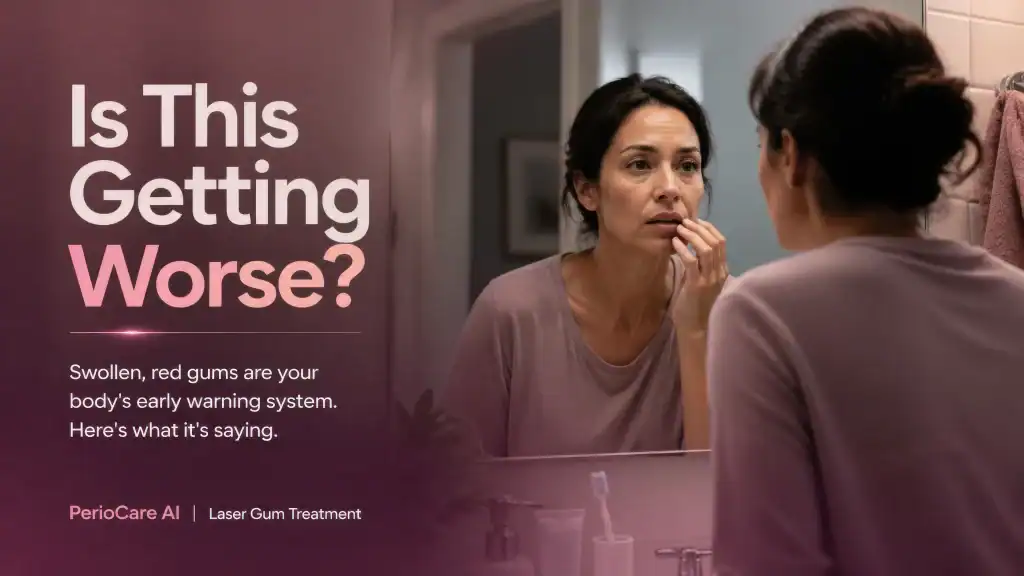
You’ve been looking at your gums in the mirror. Maybe after brushing, maybe after noticing a little blood in the sink. Something looks different — redder than it should be, puffier than normal. It doesn’t feel quite right. And even though it’s not unbearable, there’s a low-level worry that’s been sitting with you.
Is this serious? Should I be doing something? Is it going to get worse?
Those are exactly the right questions to be asking.
What You Might Be Feeling
There’s a particular kind of worry that comes with noticing something wrong with your body — especially when it’s not painful enough to feel urgent, but visible enough that you can’t ignore it.
You might be telling yourself:
“It’s probably nothing.”
“Maybe I just need to floss more.”
“I’ll keep an eye on it and see if it gets better.”
And alongside that, a quieter thought: “But what if it doesn’t?”
That tension — between wanting to believe it’s minor and knowing something feels off — is one of the most common experiences people have when gum disease is in its earlier active stages. The swelling and redness you’re seeing are your body’s immune system at work, trying to fight off bacteria that have settled into the space between your teeth and gums.
It’s not a sign that you’ve failed at oral hygiene. It’s a sign that something needs attention — and the earlier that attention comes, the simpler the path forward.

What Could Be Happening
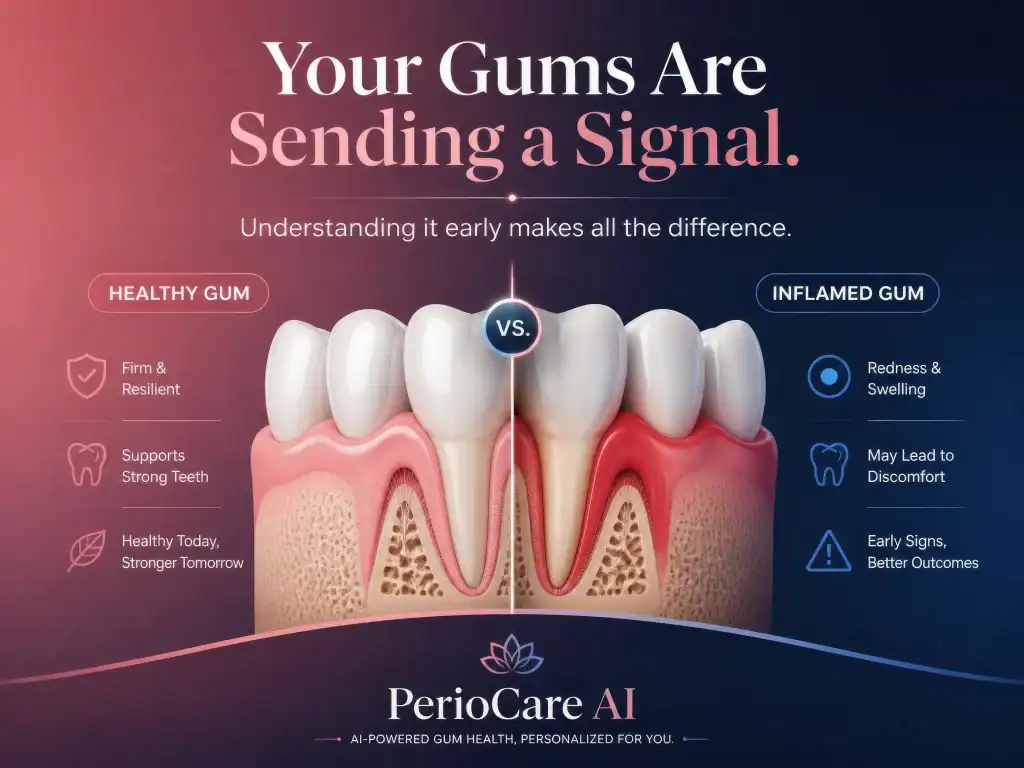
Swollen, red gums are almost always a sign of inflammation — and inflammation in the gums is almost always caused by bacterial activity.
Here’s what’s likely happening: bacteria accumulate in the pockets between your teeth and gum line. Your immune system responds by sending blood flow to the area — which is what causes the redness and puffiness you’re seeing.
If the bacteria aren’t removed, the inflammation becomes chronic, the pockets deepen, and the condition progresses from gingivitis (early-stage, reversible) to periodontitis (more advanced, requiring professional treatment).
The visual signs you’re noticing — the redness, the swelling — are actually early warning indicators. That’s important. It means you’re catching this at a stage where intervention is more straightforward, less invasive, and more effective.
What you’re seeing in the mirror is your body doing its job. Your job now is to respond.
Why People Wait (And Why It Matters)
When symptoms aren’t causing significant pain, it’s easy to rationalize waiting.
“It’s not that bad yet.”
“I’ll deal with it after the holidays.”
“I’ll just be more careful with brushing.”
This is one of the most common patterns in gum disease — and one of the most consequential. Periodontal disease is often called a “silent” condition because it progresses without dramatic pain signals until it’s significantly advanced.
The swelling and redness you’re seeing now are actually the loudest warning signs you’re likely to get before things become more serious.
There’s also the fear of what a dentist might say. Nobody wants to sit down and be told they have a problem — especially one that might involve treatment. But here’s the truth: what you’re describing right now is exactly the kind of situation where modern treatment options are at their most effective and least invasive.
Waiting doesn’t make the conversation easier. It makes the treatment more complex.

What Most People Do Next
When people at this stage finally seek care, they’re often relieved to discover that treatment doesn’t look the way they feared.
Laser gum treatment — the kind used in LANAP-style protocols — works by using a precise laser to target the bacteria and infected tissue in the gum pockets, without cutting healthy tissue. It’s gentle, it’s effective, and it works with your body’s natural healing process rather than against it.
For people who are at the stage you’re describing — visible inflammation, early-to-moderate gum disease — laser treatment often produces excellent results with minimal discomfort and a much faster recovery than traditional approaches.
The earlier you address it, the better the outcome. And the better the outcome, the simpler the process.
You’re Not Overreacting — And You’re Not Too Late
If you’ve been second-guessing whether this is worth worrying about, let us be clear: noticing these signs and taking them seriously is exactly the right response.
You don’t need to have all the answers before you take a next step. You don’t need to know what treatment you want or whether you’re ready for it. You just need to understand what’s happening — and know that there are calm, clear, non-scary ways to address it.
This isn’t about alarm. It’s about awareness. And you already have that.
Let’s Figure This Out Together
📞 Call Us: A quick conversation can tell you a lot. Our CarePath team is here to help you understand what you’re seeing and what it might mean — without pressure or judgment.
📅 Book A Symptom Assessment: Low-pressure, informative, and focused entirely on giving you clarity. That’s the whole point.