Your Gums Have Been Trying to Get Your Attention
Soreness and sensitivity aren’t just discomfort — they’re communication. And what your gums are saying is worth hearing.
It’s not dramatic. It’s not an emergency — at least not yet. But something has shifted. Your gums feel tender when you brush. Maybe certain foods cause a twinge. Maybe you’ve noticed you’re being more careful, more gentle, almost without realizing it.
It’s the kind of thing that’s easy to dismiss. But you haven’t dismissed it — because something about it feels like it matters.
That instinct is worth trusting.
What You Might Be Feeling
Gum soreness and sensitivity have a way of existing in the background — present enough to notice, subtle enough to rationalize away.
You might be thinking:
“Maybe I brushed too hard.”
“It’s probably just stress.”
“I’ll see if it goes away on its own.”
And maybe it will. But maybe it won’t. And the uncertainty of not knowing which is true is its own kind of discomfort.
What you’re describing — soreness, sensitivity, a general feeling that something is off — is one of the earliest and most important signals that gum tissue is under stress. It doesn’t mean you’re in crisis. It means your body is asking for attention before things escalate.
The people who catch gum disease early — at exactly this stage — are the ones who have the most options, the least invasive paths forward, and the best outcomes. You’re in that window right now.

What Could Be Happening
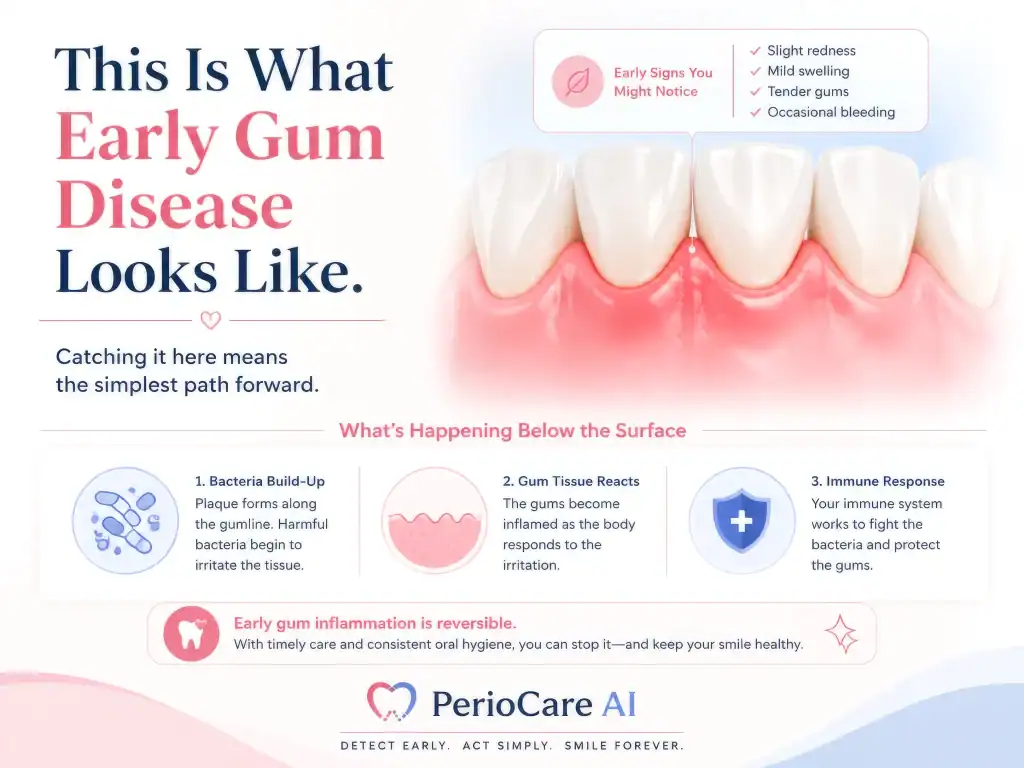
Gum sensitivity and soreness are typically signs of early inflammation in the gum tissue.
When bacteria accumulate along the gum line — in the small pockets between your teeth and gums — your immune system responds. That response causes the tissue to become more sensitive, more reactive, and sometimes slightly swollen or tender to the touch.
At this stage, the condition is often still in the gingivitis range — meaning it’s early, it’s active, and it’s responsive to treatment. The tissue hasn’t yet experienced significant structural damage.
The pockets haven’t deepened to the point where bacteria are unreachable by professional cleaning.
This is the stage where intervention is most effective and least complex. Not because things are urgent — but because acting now keeps them from becoming urgent.
Think of it like a small leak in a roof. It’s not a crisis today. But the longer it goes unaddressed, the more it costs to fix.
Why People Wait (And Why It Matters)
When symptoms are mild, the motivation to act is easy to postpone.
There’s no sharp pain pushing you toward the phone. There’s no visible crisis demanding immediate attention. There’s just a low-level awareness that something isn’t quite right — and a very human tendency to hope it resolves on its own.
Most people also carry some version of dental anxiety. Even if it’s not severe, the idea of sitting in a dental chair and potentially hearing something you don’t want to hear creates a kind of avoidance that feels easier than facing it.
And then there’s the assumption that treatment means something dramatic — surgery, recovery, expense. That assumption keeps a lot of people from seeking care at exactly the stage when care is simplest.
Here’s what’s true: at the level of sensitivity and soreness you’re describing, the treatment options are typically gentle, minimally invasive, and far less involved than most people expect.
The window you’re in right now is actually the best possible time to have this conversation.

What Most People Do Next
People who address gum sensitivity at this stage are often surprised by how straightforward the process is.
Laser gum treatment — used in protocols like LANAP — is particularly well-suited for early-to-moderate gum disease. The laser precisely targets bacteria in the gum pockets, reduces inflammation, and stimulates the tissue to heal and reattach. There’s no cutting, no stitches in most cases, and the recovery is typically minimal.
For someone at your stage — noticing sensitivity, catching things early — this kind of treatment is often completed in a single session per quadrant, with patients returning to normal activity quickly.
The earlier the intervention, the gentler the process. That’s not a sales pitch — it’s just how gum disease works.
You’re Ahead of Most People — And That’s Worth Something
The fact that you’re paying attention to something subtle — not waiting for it to become a crisis — puts you in a genuinely good position.
Most people don’t seek care until the pain is hard to ignore. You’re here before that point. That matters.
This isn’t about rushing into anything. It’s about understanding what’s happening so you can make a calm, informed decision — not a reactive one made under pressure.
You’ve already done the hardest part: you noticed, and you’re taking it seriously.
Let’s Start With a Conversation
📞Call us: Our CarePath team can help you understand what your symptoms might mean and what a next step could look like — no pressure, no clinical overwhelm.
📅Book A Symptom Assessment: A simple, informative conversation. That’s all it needs to be right now.