“The Pain Won’t Wait Anymore”: What to Do When TMJ Becomes Impossible to Ignore
When sharp jaw pain stops being background noise and starts taking over your day, your body is asking for more than a painkiller.
You woke up this morning and it hit you before you even got out of bed. Not a dull ache. Not the usual tightness. Something sharper. Something that made you stop mid-yawn and hold your jaw like it might break. You’ve been here before — but not like this. This time, it’s different. This time, you can’t push through it.
If that’s where you are right now, this article is for you.
What This Feels Like Day to Day
The morning starts with your jaw already clenched. You didn’t sleep well — again. There’s a radiating ache that runs from your jaw up into your temple, sometimes down into your neck. You try to eat breakfast and every chew sends a small shock through your face. You take ibuprofen. You move on. But by midday, the pain is back, louder.
At your desk, you catch yourself pressing your fingers against your jaw without realizing it. The tension has become a constant companion — one you didn’t invite and can’t seem to shake. By evening, you’re exhausted in a way that goes beyond tired. It’s the kind of fatigue that comes from fighting pain all day long.
This isn’t just discomfort. This is your body sending an urgent signal.

What Could Be Causing This
The temporomandibular joint — your TMJ — is the hinge that connects your jaw to your skull. It’s one of the most complex joints in your body, responsible for every bite, every word, every yawn. When something goes wrong here, the effects ripple outward.
Sharp, urgent TMJ pain often points to one or more of the following:
Joint inflammation or disc displacement. The small disc that cushions your jaw joint can shift out of position, causing sudden, intense pain — especially when opening or closing your mouth.
Muscle overload. If you clench or grind your teeth (often during sleep, often without knowing it), the muscles around your jaw become chronically overworked. Eventually, they stop recovering. The pain becomes constant.
Bite misalignment. When your upper and lower teeth don’t meet correctly, your jaw compensates — and that compensation creates strain that builds over time until it breaks through as acute pain.
Stress-triggered tension. Emotional stress doesn’t stay in your mind. It lives in your body — and for many people, it lives specifically in the jaw.

Why It Often Goes Misdiagnosed
Here’s what makes TMJ so frustrating: it rarely gets diagnosed correctly the first time.
You may have been told it’s tension headaches. Or stress. Or that you just need to relax. You may have seen your primary care doctor, a neurologist, even an ENT — and walked away with no real answers. That’s not because the pain isn’t real. It’s because TMJ symptoms overlap with so many other conditions that it takes a trained eye to connect the dots.
The pain in your temple gets treated as a migraine. The ear pressure gets treated as an infection. The jaw ache gets dismissed as stress. Meanwhile, the actual source — your jaw joint and the muscles surrounding it — goes unaddressed.
This is why so many people with TMJ spend months, sometimes years, in a cycle of partial treatments that never quite work.

What TMJ Treatment Actually Looks Like
The good news: treating TMJ doesn’t have to mean surgery. In fact, the most effective approaches are conservative, non-invasive, and highly personalized.
A proper TMJ evaluation starts with understanding your specific pattern — where the pain originates, what triggers it, how your bite functions, and what’s happening in the joint itself. From there, a treatment plan might include:
- A custom occlusal splint designed to reposition your jaw and reduce muscle tension
- Physical therapy targeting the jaw, neck, and surrounding muscles
- Bite correction to address underlying alignment issues
- Botox injections to relax overactive jaw muscles
- Stress management strategies that address the neurological component
The key word is personalized. What works for one person may not work for another. That’s why a proper diagnosis — not a generic night guard from a pharmacy — is the starting point.
You’ve Been Carrying This Long Enough
If the pain has reached the point where you can’t ignore it, that’s not weakness — that’s information. Your body has been patient. It’s been sending smaller signals for a while. Now it’s speaking clearly.
You don’t have to keep managing this alone. You don’t have to keep guessing whether it’s “serious enough” to address. Sharp, persistent TMJ pain is serious enough. You are serious enough.
This isn’t about rushing into anything. It’s about finally getting a real answer — one that’s specific to your jaw, your symptoms, your life.
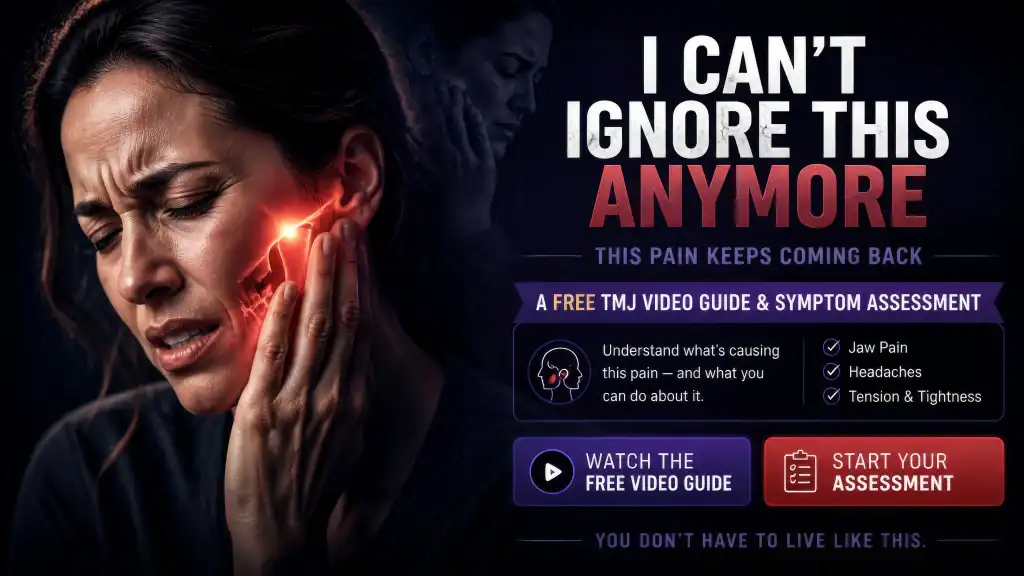
Ready to Take the Next Step?
Talk to someone who understands TMJ. Our team is here to listen — not to rush you, not to overwhelm you, but to help you understand what’s happening and what your options are.
📞 Call us to speak with a TMJ CarePath specialist — a real conversation, no pressure, no commitment.
📅 Or book a Symptom Assessment at a time that works for you. We’ll walk through your symptoms together and help you find a path forward that actually makes sense.